
AI-Native Product Series: Pt 1
Designing, Developing, and Evaluating AI-Native Product Ecosystems
As AI becomes embedded across product ecosystems, organizations are recognizing that designing, developing, and evaluating AI-driven experiences is not simply an extension of what we’ve always done. Agentic systems behave differently from traditional software, and that difference reshapes how we define quality, manage risk, and understand user behavior.
My perspective comes from working at the intersection of UX, quantitative analysis, modeling, and product strategy. Deterministic assumptions break down, variability becomes a design constraint, and evaluation requires more than surface-level usability metrics. Teams are wrestling with how the system behaves, how people respond to that behavior, and how the two influence one another over time.
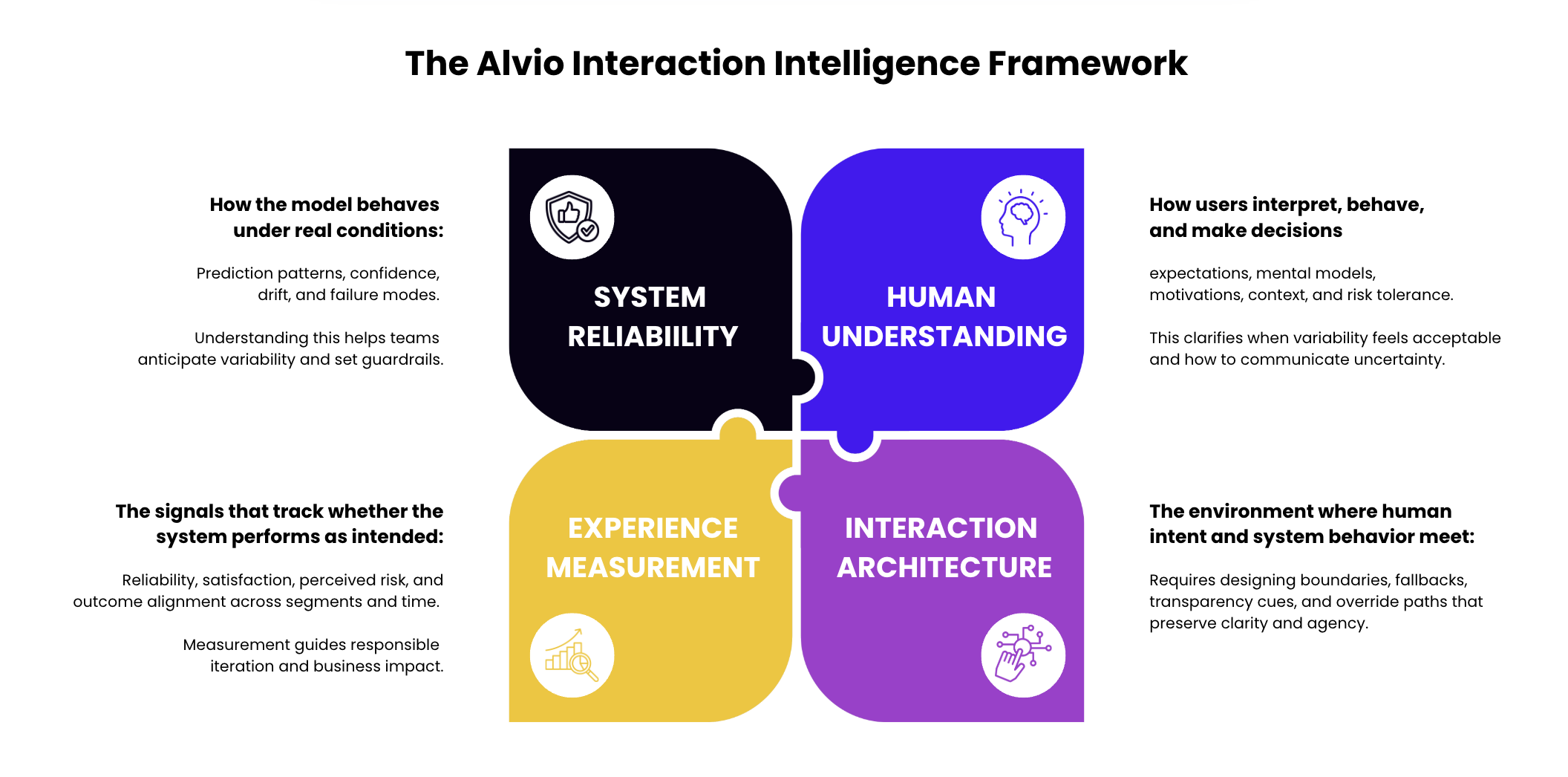
To help teams navigate that shift, I developed the Alvio Interaction Intelligence Framework. It focuses on four connected areas: understanding system behavior, understanding human behavior, designing the interaction space, and measuring the experience. The rest of this article introduces the core concepts behind this framework.
Core Considerations of AI-Native Experience
Before diving into the the framework, it helps to ground the value of this shift. When teams treat AI as predictable software, they ship brittle interactions, miss early indicators of drift, and struggle to understand why trust and adoption falter. When they treat AI as a system that learns, adapts, and participates in the interaction, they gain earlier visibility into issues, make stronger product decisions, reduce operational risk, and create experiences that sustain trust over time.
The following considerations reflect my recent experiences as I’ve navigated organizations investing in AI design, development, and evaluation.





The Alvio Interaction Intelligence Framework
Taken together, these dimensions describe what AI-native work feels like in practice. To turn that into something teams can use every day, I rely on the Alvio Interaction Intelligence Framework.
Click each tile to explore how the system, the human, the interaction space, and measurement work together in AI-native products.
The Alvio Interaction Intelligence Framework
AI-native products require teams to reason about system behavior and human behavior together. Traditional software separates these concerns, but AI ties them tightly through probabilistic outputs, adaptation, and ongoing learning.
The Alvio Framework for AI-Native Product Development provides a structure for understanding where to focus, how to define quality, and how to build experiences that remain reliable as the system evolves.
What This Series Will Cover Next
Next time, we will take a deeper look at the Alvio Interaction Intelligence Framework. This includes how to assess system behavior, understand user expectations, design for variability, and build measurement into the product from the start.
The final part of the series will turn the framework into practice. It will cover how to strengthen measurement, trust, failure mode design, and drift detection, and how cross-functional teams can put these pieces to work in real product environments.
Together, this offers a practical and strategic view of the competencies needed to build AI-native products, from understanding the shift to structuring the work to running AI products responsibly over time.
‘Til next time, I’m Bianca
